

Joined January 2009
- Tweets 28,176
- Following 859
- Followers 406
- Likes 13,663
2,219 Photos and videos








Sir Not-Appearing-in-this-Film retweeted

Feb 20
Of course we all remember how Boeing fairly won the KC-X contract for 179 refueling aircraft against Airbus back in 2011.

The United States opposes any efforts to incorporate European preference in the EU Defense Procurement Directive. We fully support European rearmament and a revitalization of the European defense industrial base. However, European preference in the Directive would undermine member state flexibility to make national procurement purchases, hinder European rearmament efforts, create barriers for Allies reaching NATO capability targets, and run counter to European commitments in the 2025 U.S.-EU Joint Statement on trade and Reciprocal Defense Procurement Agreements.
Our full statement here:
ec.europa.eu/info/law/better…
18
212
2,099
98,534
Sir Not-Appearing-in-this-Film retweeted

Feb 20
The Supreme Court’s ruling, by a clear 6-3 majority, that President Trump’s global tariffs are illegal is historic.
It’s also a real headache for the President.
Tariffs were his signature economic policy.
Now he might not just lose his favourite policy took but have to repay the tens of billions already levied and taken from US companies.
Of the six who voted against the President, three are liberal, three are conservative.
119
77
666
120,221
Sir Not-Appearing-in-this-Film retweeted

Feb 20
In the current climate, I would go as far as to call this treasonous…
Feb 20

EXCLUSIVE: Donald Trump has repeatedly flipped on a U.K. plan to cede sovereignty of the Chagos Islands.
Behind the scenes, former British prime ministers Liz Truss and Boris Johnson have been lobbying to sway the U.S. president against the deal.
🔗 politico.eu/article/boris-jo…

296
285
1,023
88,797
Sir Not-Appearing-in-this-Film retweeted

Feb 18
I'm old enough to remember when the Chagos deal was a top American priority, essential to preserve the Special Relationship

I have been telling Prime Minister Keir Starmer, of the United Kingdom, that Leases are no good when it comes to Countries, and that he is making a big mistake by entering a 100 Year Lease with whoever it is that is "claiming" Right, Title, and Interest to Diego Garcia, strategically located in the Indian Ocean. Our relationship with the United Kingdom is a strong and powerful one, and it has been for many years, but Prime Minister Starmer is losing control of this important Island by claims of entities never known of before. In our opinion, they are fictitious in nature. Should Iran decide not to make a Deal, it may be necessary for the United States to use Diego Garcia, and the Airfield located in Fairford, in order to eradicate a potential attack by a highly unstable and dangerous Regime — An attack that would potentially be made on the United Kingdom, as well as other friendly Countries. Prime Minister Starmer should not lose control, for any reason, of Diego Garcia, by entering a tenuous, at best, 100 Year Lease. This land should not be taken away from the U.K. and, if it is allowed to be, it will be a blight on our Great Ally. We will always be ready, willing, and able to fight for the U.K., but they have to remain strong in the face of Wokeism, and other problems put before them. DO NOT GIVE AWAY DIEGO GARCIA!
2
6
48
9,987
Sir Not-Appearing-in-this-Film retweeted

Feb 18
I am a Jew and I would happily walk into a mosque to vote, on account of not being a massive racist
180
344
6,030
91,153
Sir Not-Appearing-in-this-Film retweeted

Feb 17
You were Attorney General in Johnson's government when this happened.

9
202
731
7,707

WTAF is he suggesting? That we go back to sixpence and guineas?
This is deranged.
38
Sir Not-Appearing-in-this-Film retweeted

Feb 15
I understand what he is trying to say, but it simply is not true to say they did not enable vassalage. There’s zero point trying to rewrite history. I love America, but it deliberately sought to constrain British and European hard power after WW2, not only in Europe but globally. The handling of Suez was a clear example. Even JD Vance has since acknowledged that, in the context of Suez, that approach was a mistake.
Feb 15

We never wanted Europe to be a vassal of the United States. We want to be their partner.
Our point continues to be that the stronger the members of NATO are, the stronger NATO will be. We want the alliance to be so strong that no one ever dares to challenge it.
@SecRubio
2
4
14
719
Sir Not-Appearing-in-this-Film retweeted

Two claims. Both wrong. Let's go.
"Roman tidal baths are at the same level"
No they aren't. And the fact that you think this proves something tells me you've never studied geology, archaeology, or oceanography.The Roman port of Ephesus is now 5 miles inland. The Roman port of Ostia Antica, Rome's main harbor, is now 2 miles from the sea. The ancient Roman port at Caesarea Maritima is partially submerged. The Roman city of Baiae in the Bay of Naples is underwater, you can literally snorkel through it. Roman fish tanks along the Mediterranean coast have been used by geologists as precise sea level markers, and they show local sea level changes of up to 2 meters depending on tectonic activity. You know what else is happening? Land moves. It's called isostatic adjustment and tectonic uplift. The Mediterranean sits on an active tectonic boundary. Some coastlines rise. Some sink. Local land movement can mask or exaggerate sea level change at any single point. That's why scientists don't measure global sea level at one bath house, they use satellite altimetry across the entire ocean. Global mean sea level has risen approximately 8-9 inches since 1900, measured by tide gauges worldwide and confirmed by satellite altimetry since 1993. The rate is accelerating, it's now rising at 3.7mm per year, double the 20th century average. Antarctica and Greenland are losing ice at roughly 150 billion and 270 billion tons per year respectively. These are measured by the GRACE satellite system to extraordinary precision. One bath doesn't disprove 30 years of satellite data covering every square mile of ocean on Earth.
"CO₂ increases plant growth"
Partially true. Completely misleading. Yes, elevated CO₂ can increase photosynthesis rates in some plants under controlled laboratory conditions. This is called the CO₂ fertilization effect.
Here's what you left out:
The effect diminishes as other nutrients become limiting, plants need nitrogen, phosphorus, and water, not just CO₂. Multiple FACE experiments (Free-Air CO₂ Enrichment - real field studies, not lab conditions) show the growth boost plateaus and declines over time as soil nutrients are depleted.Higher CO₂ reduces the nutritional value of crops. Studies published in Nature and The Lancet show that elevated CO₂ decreases protein, zinc, and iron content in wheat, rice, and soybeans. You get bigger plants with less nutrition. More calories, fewer nutrients. That's not abundance - that's a global malnutrition crisis.Meanwhile, the warming caused by that CO₂ is destroying agricultural yields through heat stress, drought, flooding, and shifting growing seasons. Global wheat yields decline an estimated 6% for every degree Celsius of warming. The U.S. Corn Belt is already experiencing yield losses from increased heat and precipitation volatility. So yes, CO₂ helps plants grow in a lab. In the real world, the warming it causes is collapsing the agricultural systems that feed 8 billion people.
"Death cult"The position you're defending will cause up to 58,000 premature deaths and 37 million asthma attacks by 2055, per the Environmental Defense Fund using the EPA's own models. The administration's own data shows it raises gas prices.I'm not the one in the death cult. I'm the one who can read the data.
32
286
1,151
34,001
Sir Not-Appearing-in-this-Film retweeted

Feb 13
Boy: "Is that the same Boris Johnson who in 2019 said money spent investigating historic child sexual abuse was being 'spaffed up a wall', Dad?
Dad: "The very same, son. The very same."
Feb 13

Boris Johnson says 'powerful men' like Bill Gates and Andrew should testify on Epstein
mirror.co.uk/news/politics/b…
29
1,291
4,834
184,163
Sir Not-Appearing-in-this-Film retweeted

Feb 13
The decision to proscribe Palestine Action under the Terrorism Act 2000 has been declared to be unlawful by the High Court as:
(a) the decision by the Home Secretary breached her own policy on when she would exercise her discretion to seek an order proscribing an organisation.
This is because she unlawfully took into account that proscription would be advantageous because it would mean that the offences at sections 11 to 13 of the 2000 Act could be used against any person supporting Palestine Action, and the statutory consequences of proscription would provide further powers to disrupt Palestine Action.
(b) the decision to proscribe was disportioncate to the very significant impact it would have on the right to freedom of assembly.
Although some of PA's actions did constitute acts of terrorism under the Terrorism Act 2000, the nature and scale of PA's activities falling within the definition of terrorism had not yet reached the level, scale and persistence to warrant proscription.
The proscription itself remains in place for now whilst the court hears submissions on what happens next.
The Home Secretary has said she will seek permission to appeal. The court has the option to keep the proscription in place until the outcome of any appeal (assuming the Home Secretary gets permission, which I suspect she would). The court could also strike down the proscription even notwithstanding an appeal, but if the HS gets permission I think the first option is more likely (this is what happened in the Liberty case re changes to the Public Order Act 1986).
The ruling and summary are here. I am just reading the judgment and may post some further thoughts in the replies to this post.
judiciary.uk/judgments/huda-…
26
122
237
54,273



In London one of the main problems are that late night licensing is controlled by local councils with no incentive to think city, let alone generationally or economy wide. Licensing should be in the hands of the Mayor to zone.
Feb 12

🚨 WATCH: Angela Rayner calls for the Government to create a Minister for Nightlife
"We need to do better. We need to recognise the value of this industry economically, culturally and socially"
2
13
114
10,477
Sir Not-Appearing-in-this-Film retweeted

Feb 12
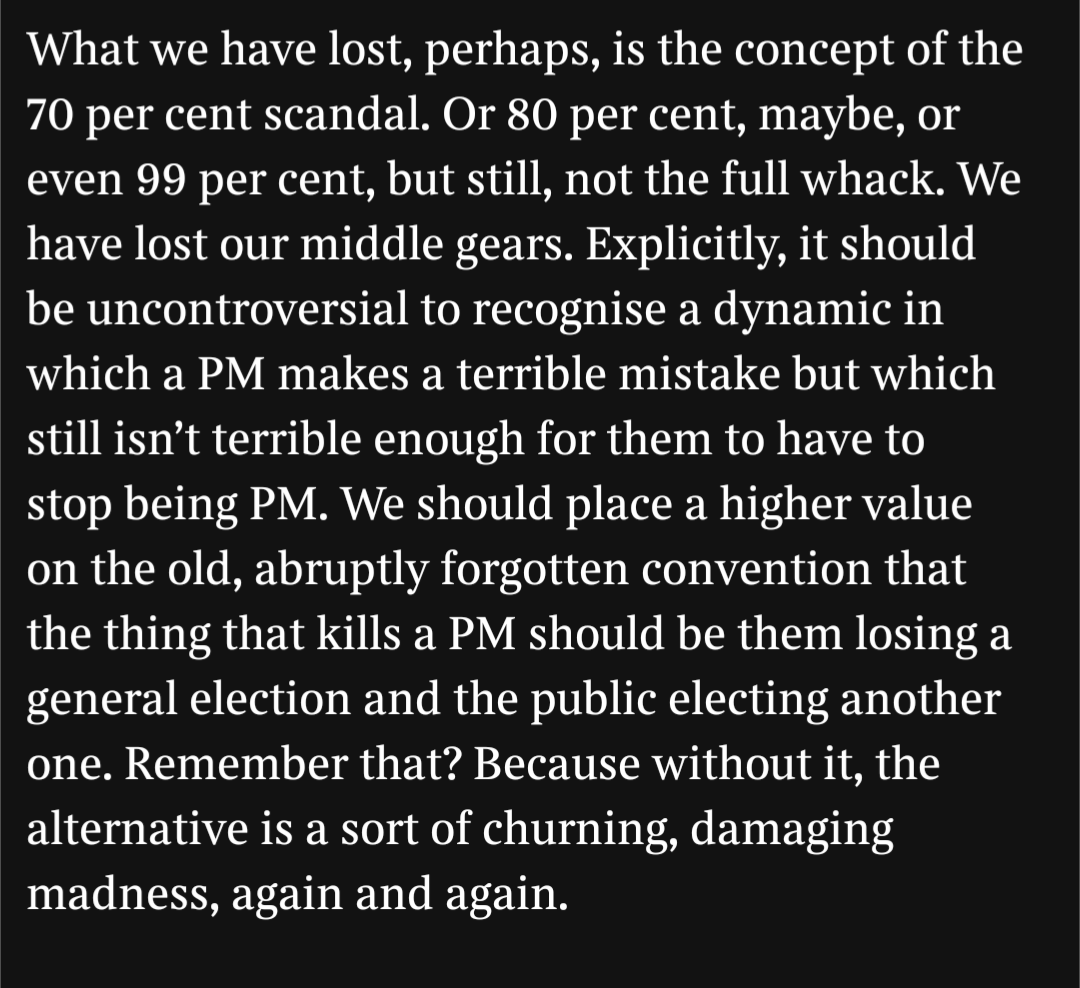
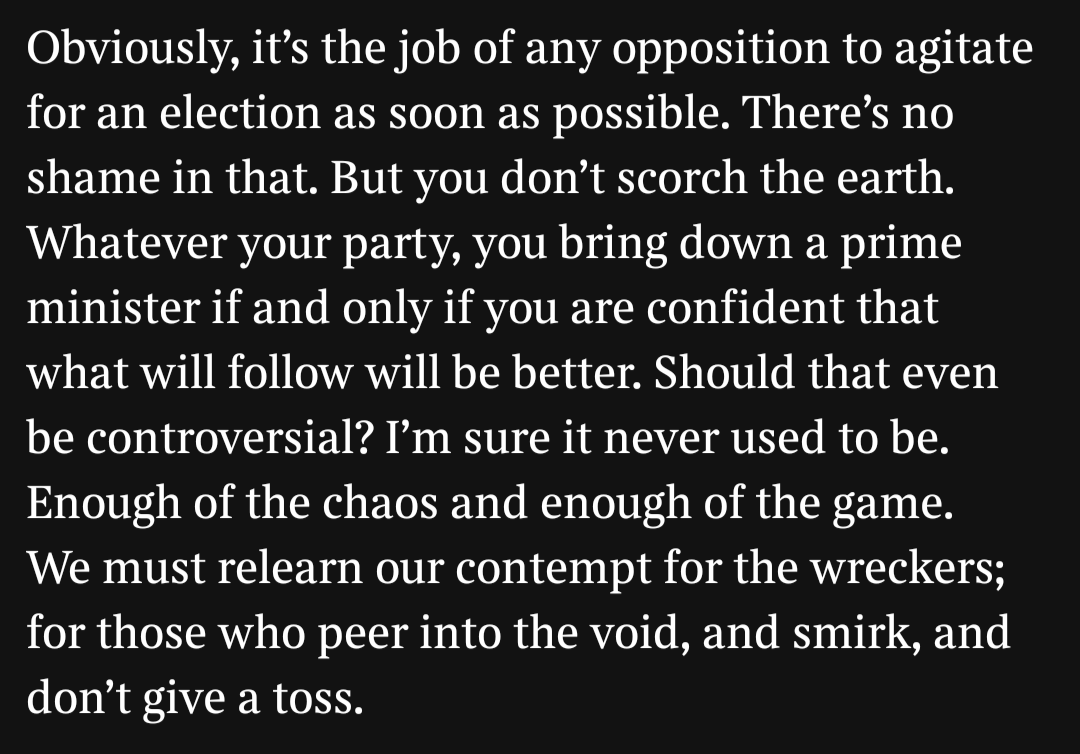
Today's column. On the abyss. thetimes.com/article/c7f89ec…
84
207
736
121,100


Sir Not-Appearing-in-this-Film retweeted

Feb 11
If Britain was a proper country you’d be able to get the Eurostar from Birmingham to Paris.
51
202
4,742
111,860
Sir Not-Appearing-in-this-Film retweeted

Feb 12
The fact that I genuinely don't know if this A.I. generated or not says all you need to know about where we're at as a species.

70
95
957
98,661
Sir Not-Appearing-in-this-Film retweeted

Feb 11
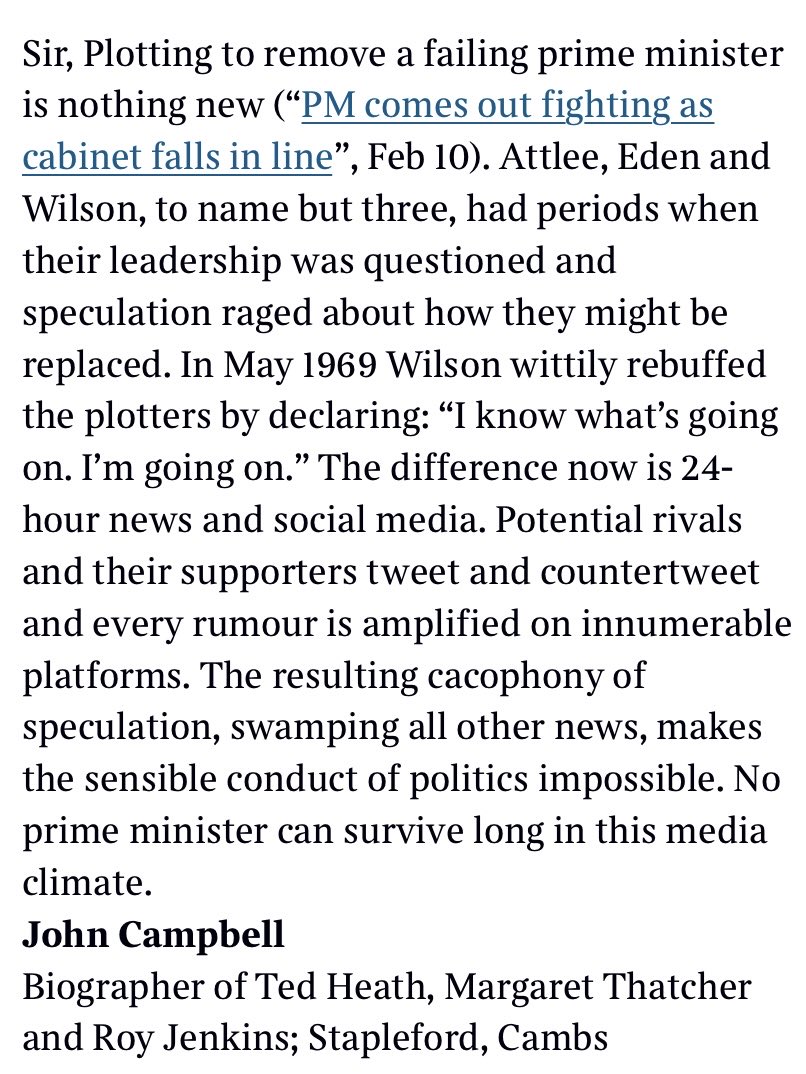
Times letter from a fantastic political biographer. And he’s spot on. ✉️
22
270
825
35,152
Sir Not-Appearing-in-this-Film retweeted

Feb 10
Listen to this. @matthewsyed gives good analysis. He's a Tory but he's also honest and realistic. Well done.
#PoliticsLive
33
97
509
44,975
Sir Not-Appearing-in-this-Film retweeted

Feb 9
How access journalism works. Every political editor/correspondent falls in love with the SpAd who provides them with scoops. Until, inevitably with McBride/Timothy/Cummings/McSweeney, the SpAd's demise becomes the next scoop. Rinse and repeat. Ad nauseam
Feb 9

Chris Mason’s inadvertently revealing @BBC piece on Starmer’s “dire” predicament is textbook Westminster insider journalism: mood, metaphor, anonymous sourcing, and ticking-clock drama frame the PM as uniquely exposed after McSweeney’s resignation.
McSweeney is lionised as the indispensable technocratic operator who “got us here,” delivered the #GE2024 landslide and acted as a protective “lightning conductor.”
Starmer, by contrast, is subtly diminished as a late entrant who “travels light ideologically” (code for thin conviction and over-reliance on elite machinery rather than political depth or vision). The implied tragedy is not governing failure, but the squandering of electoral success through personal misjudgement and the loss of sharp operatives.
Crisis is then ratcheted up through doom-laden language, dramatic metaphors and a manufactured sense of unanimity, turning insider anxiety into an apparent party-wide verdict of impending collapse.
Countervailing facts such as Starmer’s mandate, his resolve, and international standing are briefly acknowledged, then sidelined, overwhelmed by a narrative in which politics becomes Westminster soap opera: elite missteps, personalities and parliamentary mechanics crowd out policy substance or structural constraints.
Perhaps most revealing are the omissions. There is almost no engagement with governing choices, no serious attempt to explain why the Mandelson appointment angered people beyond optics, no mention of Palantir contracts, and no analysis of whether any of this turbulence matters outside SW1.
Power is reduced to position and atmosphere among elites, with the public cast as a passive audience simply reacting to Westminster drama.
Most strikingly, Mason never even mentions #Epstein. By reducing the Mandelson controversy to vague “misjudgement” and “lies,” the article depoliticises a global scandal about elite networks, vetting, and sexual abuse, reframing it instead as an internal mood crisis and a test of Starmer’s personal resilience.
All this while maintaining @BBC surface impartiality. The relentless focus on insider sentiment and technocratic competence privileges Westminster drama over governing substance, reinforcing perceptions of Starmer’s fragility rather than neutrally observing them.
Politics, in this telling, has fuck-all to do with issues that shape our lives, such as inequality, migration, media power, housing, the cost of living, taxation, or public services. It is reduced to something that happens primarily among elites, which the public then reacts to later.
From the perspective of the Masons, Kuennssbergs, Pestons and Rigbys of this world, ‘the political is personnel’.
Whereas second-wave feminism insisted that the ‘personal is political’ (that lived experience reveals underlying structures of power requiring collective solutions) my inverted aphorism names a different reality: politics is interpreted through individual competence, appointments, and elite manoeuvring, while the structural forces shaping people’s lives are relegated to background noise.
This reflects the deeper victory of a neoliberal rationality that privileges competitive individualism and elite managerial skill over collective solidarity, structural explanation, and shared purpose.
Westminster journalism doesn’t just report this worldview, it helps manufacture and sustain it, rendering structural politics unintelligible and collective alternatives invisible, while elite personalities and appointments pass for politics itself.
#Starmer #Mandelson #EpsteinFiles #Palantir
bbc.co.uk/news/articles/ce3g…
4
59
231
21,246