

@Amwajmedia | @ecfr alumna | The Arabian Peninsula and the Gulf region🔎🌍 | RT doesn’t imply endorsement
Joined September 2020
- Tweets 563
- Following 1,194
- Followers 365
- Likes 2,055
5 Photos and videos



Pinned Tweet

3 Feb 2025
Syria's interim president Al-Sharaa chose #SaudiArabia for his first international visit. That's perfect timing for my first commentary for @ecfr on how Europeans and #GCC states can support #Syria's political transition. Many thanks to @ECFRRoma @ECFRMena for this opportunity

📑 NEW @ecfr commentary by @EmilyTasinato: European & Gulf Arab states share common interests in #Syria – they should work closely together to ensure a stable transition ecfr.eu/article/all-change-h…
5
7
4,421
Emily Tasinato retweeted

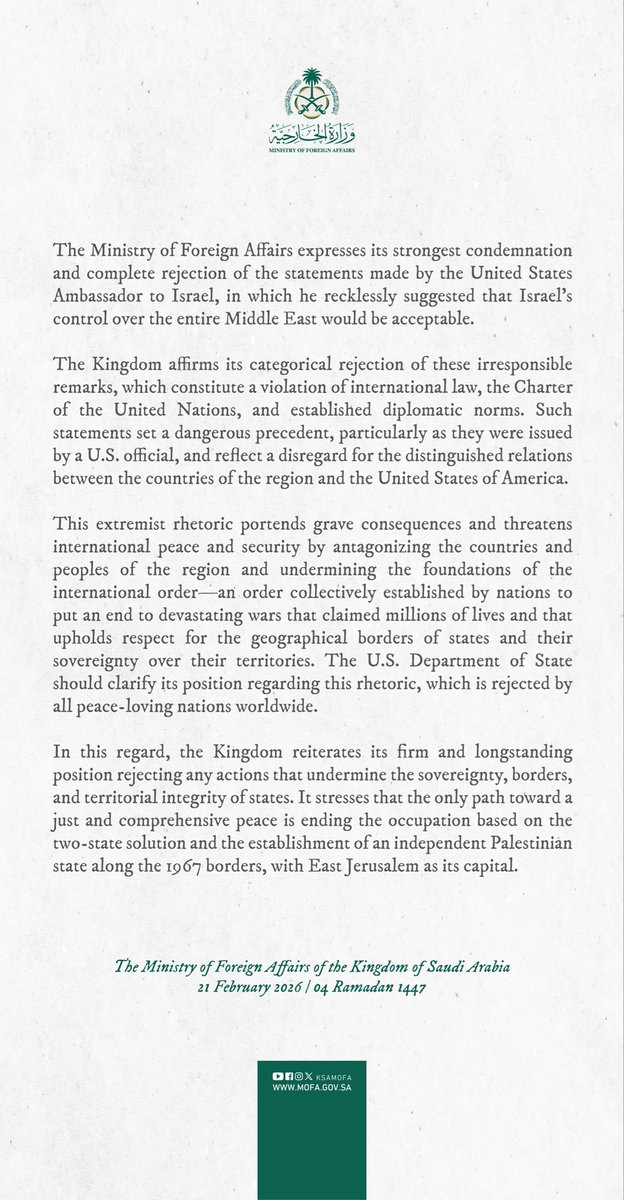
#Statement | The Foreign Ministry expresses its strongest condemnation and complete rejection of the statements made by the United States Ambassador to Israel, in which he recklessly suggested that Israel’s control over the entire Middle East would be acceptable.
809
3,821
12,929
1,853,584
Emily Tasinato retweeted

Sober, sensible analysis — and worth adding two underplayed variables: Gulf anxiety about the “day after” and Turkey’s parallel concern about uncontrolled spillover. On this, there’s more regional alignment than Washington assumes: few want state failure in Iran, even if many want Iran constrained.
So what happens if the U.S. acts anyway?
Strikes might be “bounded” militarily, but the post-strike political problem won’t be. With no coherent, organised, domestically legitimate opposition waiting in the wings, there’s no clean handover — only heightened risk of fragmentation, borderland unrest, securitised succession politics, and a harsher internal clampdown.
Gulf states — and other U.S. partners — don’t have an interest in Iran collapsing into state failure. A chaotic Iran is the nightmare scenario: cross-border instability, proxy freelancing, disruption risk to energy/shipping, and a regional security vacuum that’s harder to manage than an adversarial but functioning state.
The implication: if Washington chooses force, it needs a credible aftermath framework or it inherits escalation dynamics it can’t fully control.

Breaking the strategic Deadlock: A Different Framework for Addressing the Iran Challenge -
How can internal change be generated within the Iranian regime?
Let it be clear: if anyone could credibly guarantee that a short, contained military operation without regional spillover , would replace Iran’s current regime with a democratic, pro-Western government, I would support it without hesitation.
The fall of the Islamic Republic would be a tectonic event in the Middle East — comparable in magnitude to the 1979 revolution itself. It would fundamentally weaken Iran’s regional proxy network, from Hezbollah to the Houthis. It would dramatically reshape the strategic balance of the region. It would open the door to a very different Middle East.
But that is not the world we inhabit.
There is no credible evidence that limited military action would produce democratic transition in Tehran. There is no organized alternative leadership ready to govern. There is no mechanism by which external force alone can engineer liberal political transformation in a complex, deeply institutionalized system like the Islamic Republic.
Wishing for regime change is not a strategy. Assuming it will emerge automatically from escalation is not analysis. In the current strategic environment, it is an aspiration detached from operational reality.
And policy built on aspiration rather than probability rarely ends well in the Middle East.
So...If we begin with a sober assessment, two realities stand out.
First, the Iranian regime cannot be toppled from the air. Precision strikes may damage infrastructure, but they cannot dismantle entrenched political institutions,
And it is clear that the current regime would eventually rebuild those strategic capabilities in the absence of an agreement.
Second, there is no coherent, organized, and domestically legitimate opposition waiting in the wings. Nor do Gulf states — or U.S. partners — have an interest in Iran collapsing into state failure. A chaotic Iran would be far more dangerous than an adversarial but functioning one.
That leaves a more uncomfortable but realistic conclusion: meaningful change in Iran is more likely to come from within the system than from its overthrow - meaning Change Within the System, Not the Collapse of the System
Iran’s state institutions are resilient, even if the state itself is economically strained. The Islamic Republic is not fragile in an immediate sense. Its security apparatus is deeply entrenched, and its political elite is adaptive.
If change comes, it is likely to be evolutionary — an internal recalibration rather than revolutionary replacement.
The key inflection point may be succession. Supreme Leader Ali Khamenei’s advanced age creates a structural moment of uncertainty. At the same time, the regime faces a generational legitimacy crisis, particularly among younger Iranians who see limited economic or social opportunity under the current model. Within the system, it seems there are likely figures who understand that the Islamic Republic must “update its operating system” if it is to survive in the long term, including a discussion of the Supreme Leader’s position, with particular emphasis on the question of whether he holds ultimate executive decision-making authority.
The Nuclear Deal as a Strategic Leverage
The most realistic external lever for influencing internal evolution is the nuclear file — specifically, a structured agreement that both:
Blocks Iran’s pathway to a nuclear weapon through verifiable limits, and Unlocks substantial Western economic investment.
A deal structured around these principles would not aim at regime collapse. It would aim at strategic transformation through incentives.
Large-scale Western economic integration would gradually alter Iran’s internal balance. Economic opening would empower technocratic and pragmatic factions. It would expose the population, especially younger generations, to global markets and ideas. And it would make it far harder for the leadership to insulate society from the consequences of economic normalization.
Yes, in the short term, sanctions relief would strengthen the regime. That is unavoidable. But the alternative — open-ended confrontation or war without a defined political end state — is unlikely to produce regime change either, and far more likely to produce regional escalation.
Reducing Structural Dependence on China
Allowing Iran to legally export a defined volume of oil beyond China would also shift its geopolitical calculus. Today, Tehran’s economic dependence on Beijing is structural. Diversifying its economic outlets would dilute that dependency and subtly rebalance Iran’s external alignments.
From a U.S. strategic perspective, that is not a concession — it is leverage redistribution.
Shifting Intentions, Not Just Capabilities
Military action can degrade capabilities. It cannot reliably transform intentions. If kinetic tools cannot eliminate Iran’s technical knowledge or missile capacity, then the strategic objective must shift toward influencing decision-making inside the regime.
That means empowering those within the system who see engagement with the West as necessary for survival.
Such a process would create a degree of Iranian economic interdependence with the United States and Europe. That interdependence would, over time, constrain policy choices and incentivize moderation. It would not eliminate ideological friction. Nor would sanctions disappear entirely; penalties related to regional destabilization or human rights would likely remain.
But this would be a strategy of managed evolution rather than forced collapse.
No “Silver Bullet”
Regime change in Iran is not a “shock and awe” scenario. It is not an event. It is a process.
And while engagement carries risks, including short-term regime stabilization — it may still offer a more plausible pathway to long-term transformation than military escalation, which has repeatedly failed to produce sustainable political outcomes in the region.
If there is no viable kinetic solution to Iran’s nuclear challenge, then influencing the regime’s trajectory from within may be the only serious strategic alternative that drives from the other problematic solution to the Iranian problem.In a world where there is no clear good option versus bad option and where all the alternatives carry significant drawbacks, each path must be evaluated on its own merits.
Is this a viable option? It is far from certain. But what is clear is that the other alternatives are no more feasible and carry with them serious risks to regional stability.
#Iran
1
2
10
2,366
Emily Tasinato retweeted

Today’s indirect negotiations between The Islamic Republic of Iran and the United States of America in Geneva concluded with good progress towards identifying common goals and relevant technical issues. The spirit of our meetings was constructive. Together we made serious efforts to define a number of guiding principles for a final deal. The contribution of the IAEA Director General Rafael Grossi was much appreciated. Much work is yet to be done, and the parties left with clear next steps before the next meeting.
622
294
1,172
239,463
Emily Tasinato retweeted

🚨Quite the reunion between the Emirati and Qatari ruling families in Abu Dhabi today.
In attendance, alongside MbZ and Tamim, on the UAE side:
• Mansour bin Zayed, UAE vice president
• Tahnoun bin Zayed, national security adviser
• Saif bin Zayed, minister of interior
On the Qatari side:
• Khalifa bin Hamad, minister of interior
• Joaan bin Hamad, senior member of the House of Al Thani
This isn’t “just another meeting.” This is high-stakes diplomacy.


New🇶🇦🇦🇪: #Qatar’s emir says his “brotherly” meeting with #UAE President MbZ in Abu Dhabi focused on boosting bilateral cooperation and reviewing regional developments, with both sides stressing the need to enhance dialogue and stability.
The language is notable.
Talk of “regional developments” and “strengthening dialogue” comes as war-risk chatter around #Iran rises, and as tensions simmer between Riyadh and Abu Dhabi, making this unscheduled visit more than just protocol.
12
31
14,528
Feb 14
Saudi shakes up ministers amid pressure to attract foreign cash semafor.com/article/02/12/20…

27
Emily Tasinato retweeted

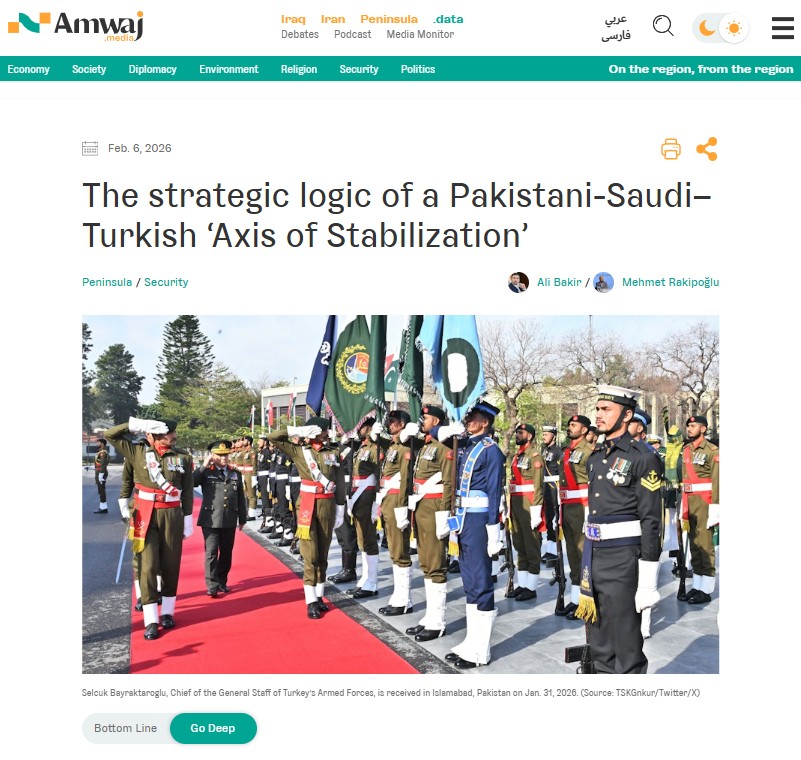
🇵🇰🇸🇦🇹🇷 I am delighted to share with you our most recent article with @RakipogluMehmet on: The strategic logic of a #Pakistani-#Saudi-#Turkish ‘Axis of Stabilization’.
Although geographically distinct, these theaters are strategically interconnected, and developments in one increasingly reverberate across the others. Each of these fault lines directly affects the strategic interests of #Ankara, #Islamabad and #Riyadh—not only within their immediate neighborhoods but across the broader regional order. These pressures have reinforced a shared understanding that fragmentation and unmanaged competition benefit external actors and regional spoilers, while core regional powers bear the costs of instability. Against this backdrop, coordination among #Pakistan, #Saudi Arabia and #Türkiye appears less ideological and more structural.
Against this backdrop, the logic of a #Pakistani-#Saudi-#Turkish alignment becomes clearer. Each of these states has a genuine interest in stabilizing West Asia as a prerequisite for addressing their own internal challenges and securing the region. #Saudi Arabia’s economic transformation agenda requires a predictable security environment to attract investment and sustain long-term growth. #Türkiye’s maintenance of its rise as an extra-regional power depends on its ability to reduce its exposure to foreign economic and political pressure and to stabilize West Asia through regional partnerships. #Pakistan, facing chronic economic strain and enduring security threats, has a vested interest in diversifying its strategic partnerships beyond its immediate neighborhood to further improve its internal situation and also to protect itself amid a western push to empower India as a strategic partner to Israel and a counter balance to China.
What makes the idea of alignment particularly compelling is its structural complementarity. Saudi Arabia brings its energy resources, financial power, and geopolitical weight; Türkiye contributes advanced military capabilities, operational experience and historic institutional culture and depth; and, Pakistan adds nuclear deterrence, manpower and a battle-hardened security establishment. Individually constrained, together they form a coherent strategic core.
Yet this emerging nexus is not without significant challenges...
More Details on this and how Israel and #Iran are related to this TRIO at
amwaj.media/en/article/the-s…
via @amwajmedia
30
69
11,336
Emily Tasinato retweeted

Feb 3
Al Mayadeen, citing political sources in Teheran, reports that Iran would like Muscat to host the next round of negotiations.
Consultations on finalizing the format and venue are still ongoing.
#Iran
1
17
29
9,116
Emily Tasinato retweeted

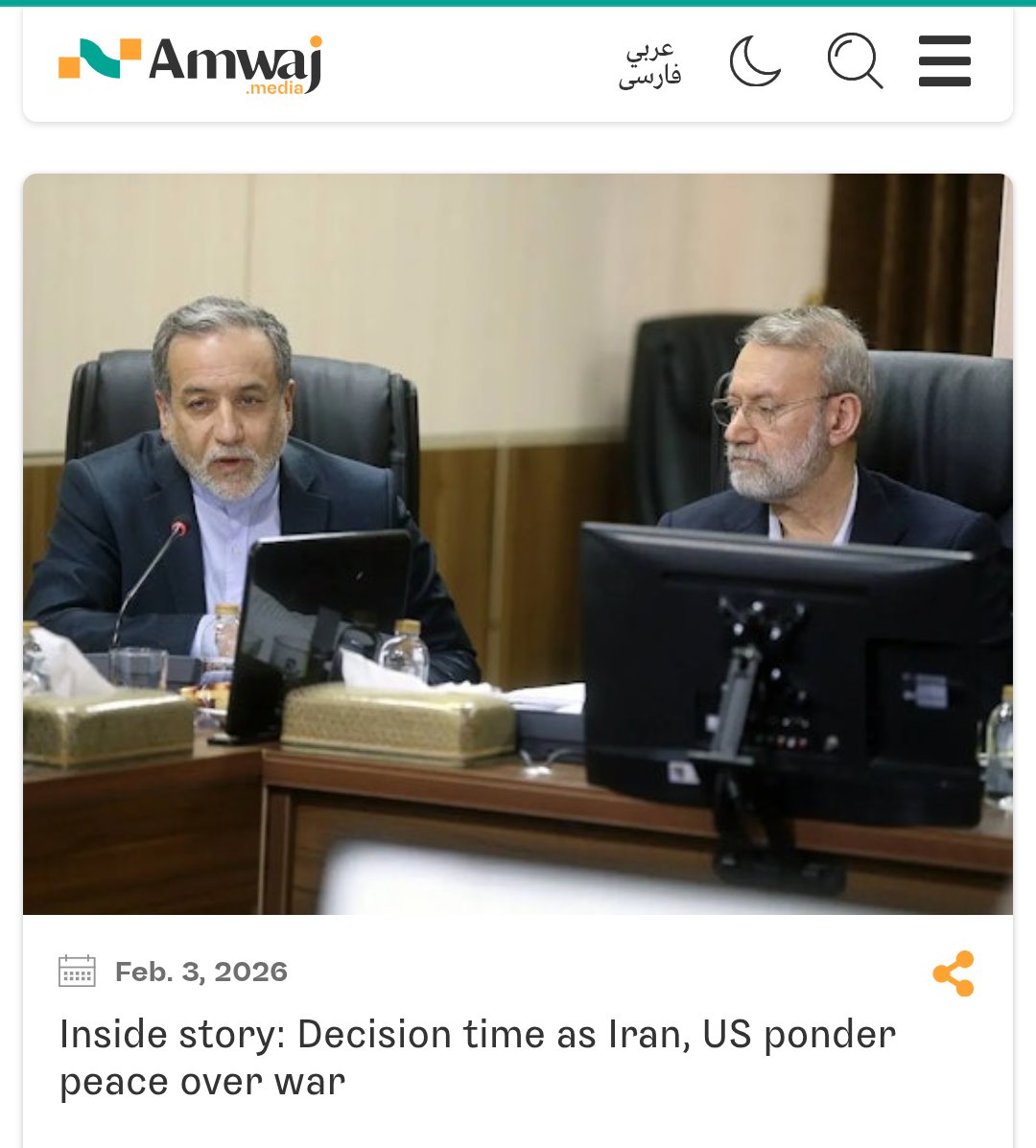
NEW: Extensively sourced deep dive into
- Dynamics within Iran's power structure on eve of expected talks
- Araghchi & Larijani's mandates
- Iran's calculations and concerns re: negotiations with Trump
- How talks on regional influence may look
- Real stumbling block: missiles
10
55
165
90,693
Emily Tasinato retweeted

Jan 19
The Myth of an IRGC Coup
In my latest analysis on Iran Analytica, I examine why speculation about an IRGC coup misreads how power actually works in #Iran and why succession, not seizure, is the real fault line 👇
irananalytica.org/p/the-myth…

1
133
419
144,968
Jan 17
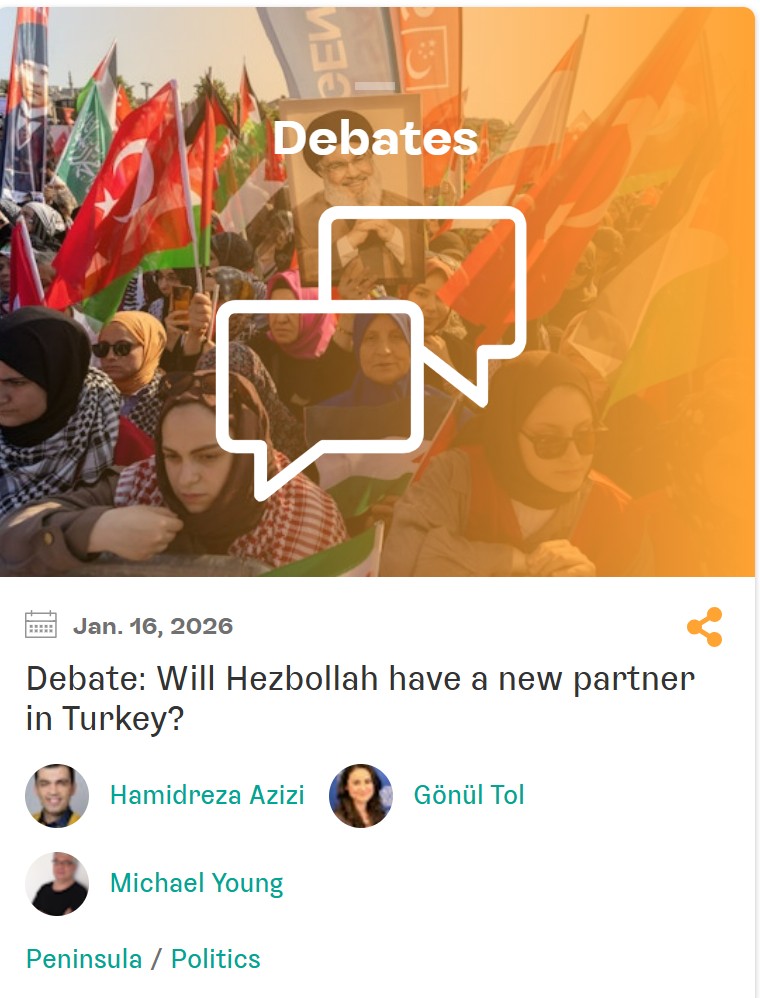
Will the rise of Turkish influence in the Levant—and potential supplanting of Iran's role as a top rival of Israel—effectively pave the way for a new relationship between Ankara and Hezbollah? Check out @amwajmedia’s new debate featuring @HamidRezaAz @gonultol & @BeirutCalling
Jan 17

With the war in Gaza, setbacks in Lebanon, and the fall of Assad all diminishing Iran's strategic depth, could Hezbollah find an unlikely new partner in Turkey? 🇱🇧🇹🇷
Experts @HamidRezaAz, @gonultol, and Michael Young (@BeirutCalling) discuss the future of the group in @amwajmedia's latest debate 👇
🔗amwaj.media/en/debate/debate…
#Hezbollah #Turkey #Iran #Syria
2
4
1,240
Emily Tasinato retweeted

Jan 14
Much indicates now that a US/Israeli war with Iran is imminent.
I see three scenarios: 1) A limited strike, mainly symbolic so that Trump can claim victory and then move to talks.
2) Regime decapitation by attacking most but not all political and IRGC leaders, but with the aim of having someone else from within the system take over afterwards in order to avoid instability. Followed by a deal manifesting Iranian capitulation.
3) A combination of 2 but with massive bombardment of Iran's military capabilities afterward to ensure that Iran is set back decades and cannot pose any challenge to Israel for the foreseeable future. Think Syria after Assad fell.
Of these three, I find option 1 very unlikely.
The argument against option 2 is that the Israelis would not accept it. Netanyahu has been very very silent publicly, which he probably would not have been if option 2 was the one favored by Trump.
The argument against option 3 is that it would likely require far more US assets in the region and we do not see that - at least not quite yet.
Of course, plans rarely survive contact with reality. Plenty of reasons why things won't play out as the US and Israel may have intended, including of course, how Iran responds/retaliates.
213
337
1,329
291,984
Emily Tasinato retweeted

Jan 13
الأكيد أن الرياض ستحافظ على قناة دبلوماسية مفتوحة ونشطة مع إيران، مع دعمها الخفي لسياسة الاحتواء. والأكيد أيضًا أن #الرياض استفادت استفادة غير مباشرة من تحجيم إيران وكسر شوكتها في الأعوام الأخيرة، كما كان سقوط #الأسد ذا فائدة استراتجية ضخمة للسعودية. لكن مع هذا كله فإن الانهيار الكامل للنظام قد يُطلق العنان لفوضى أضرارها أكبر من فوائدها، وقد تستغلها أطراف عدة لا تريد خيرًا للسعودية للإضرار بها. كما أن التجارب أثبتت أن تحويل المنطقة كاملة إلى منطقة أمريكية، في حالة استبدال النظام الإيراني الحالي بنظام موالٍ تمامًا للولايات المتحدة، قد يحمل معه الكثير من التبعات السلبية على #السعودية وعلى الخليج عمومًا.
Jan 13

سؤال المليون تومان: هل ستستفيد السعودية، من بقاء النظام أم من انهياره؟
مقالتي الجديدة المنشورة الآن #ثمانية
thmanyah.com/post/1mpadanhaf…
5
12
75
29,378
Emily Tasinato retweeted

Jan 12
🔴LIVE | Iran at a Crossroads: Protests, Repression, and the Risk of U.S. Military Escalation
A conversation featuring @vali_nasr, @mashabani, Ellie Geranmayeh, @tparsi
x.com/i/broadcasts/1dRKZaNkp…

3
16
29
13,234
Emily Tasinato retweeted

Very helpful critique from @EyadAlRefaei of the UAE foreign policy narratives about their strategy is conflict zones like Yemen and Sudan 👇
1
1
7
3,439
Emily Tasinato retweeted

Jan 8
NEW: After Saudi-backed forces rolled back the STC in 🇾🇪 #Yemen, Riyadh is calling southern factions to the table.
Can dialogue succeed after battlefield gains reshaped the balance of power?
More via @amwajmedia👇
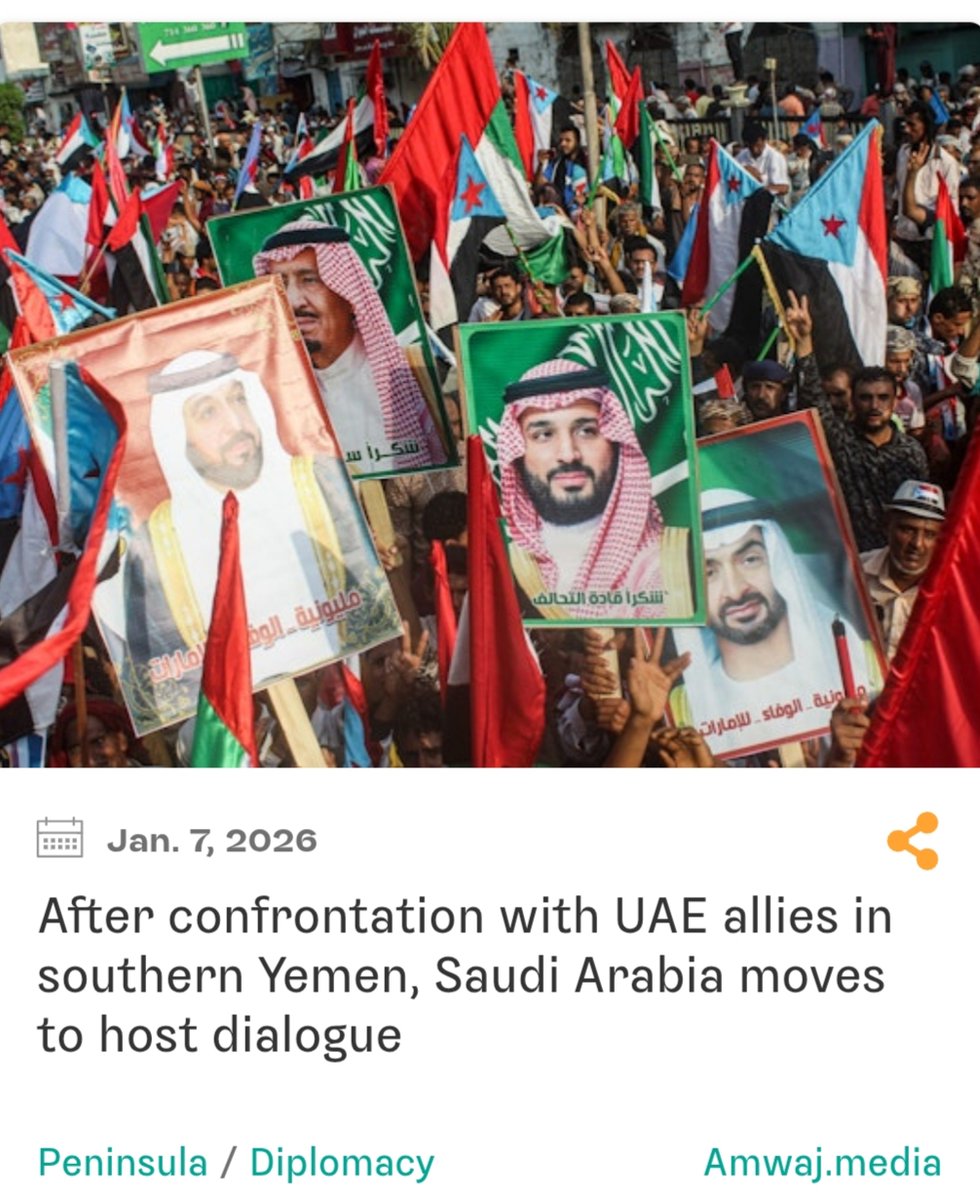
1
1
398
Emily Tasinato retweeted

Yesterday's statement by #Yemen's #UAE-backed separatist Southern Transitional Council (STC) condemning #Saudi air strikes demonstrates how the same reality can be interpreted very differently.
◾️It frames the clash as North vs South.
✏️Note: The North-South framing evokes history, but it fails to take account of residents of the former “South” who are pro-government, especially in #Hadramawt & #Mahra. The use of “North” also has the effect of lumping together the government with its Houthi enemy. This new faultline is more about East vs West.
◾️It describes Saudi strikes as a “serious military war being waged against South Arabia”.
✏️Note: Saudi air strikes were limited to positions in Hadramawt deemed occupied by separatist forces & came at the request from the President of Yemen’s internationally recognized government.
◾️It raises the spectre of terrorism, warning that terror groups & the Houthis will benefit from the instability.
✏️Note: This is true. The question is who should back down to ensure stability is restored.
◾️It accuses Saudi of “overriding the will of the people of the South”.
✏️Note: In the absence of a referendum, the will of people in the south is not known. The will of the #STC and its supporters is known.

1
20
94
16,308
Emily Tasinato retweeted

23 Dec 2025
Who comes after Khamenei is no longer a distant or theoretical question in Iran. I break down how succession actually works inside the Islamic Republic explaining why the field is far narrower than many assume with only a few serious names truly in play.
amwaj.media/en/article/hassa…

3
8
11
4,576
Emily Tasinato retweeted

Jan 2
Allies become liabilities as Saudi-UAE tension spiral in Yemen amwaj.media/en/article/uae-s… via @amwajmedia
My latest article on — and perhaps a quiet plea to — the #UAE and #Saudi Arabia.
#Yemen #GCC #Diplomacy #STC #Somaliland #Normalization
@ChathamHouse @CH_MENAP
2
11
25
5,514
Emily Tasinato retweeted
11 Dec 2025
🇮🇶 #Iraq’s latest elections have revived questions about whether the country’s fragmented party landscape still serves its democracy.
Is it time for Iraq to field bigger, more effective parties?
@omar_nidawi, @NancyEzzeddine and @renadmansour weigh in for @amwajmedia👇

1
7
4
752
Emily Tasinato retweeted

11 Dec 2025
'Reducing the number of parties... would not, on its own, improve democratic performance. Even with fewer parties, Iraq’s consensus-based system would still force post-election bargaining,' writes @renadmansour via @amwajmedia.
amwaj.media/en/debate/debate…

3
3
862